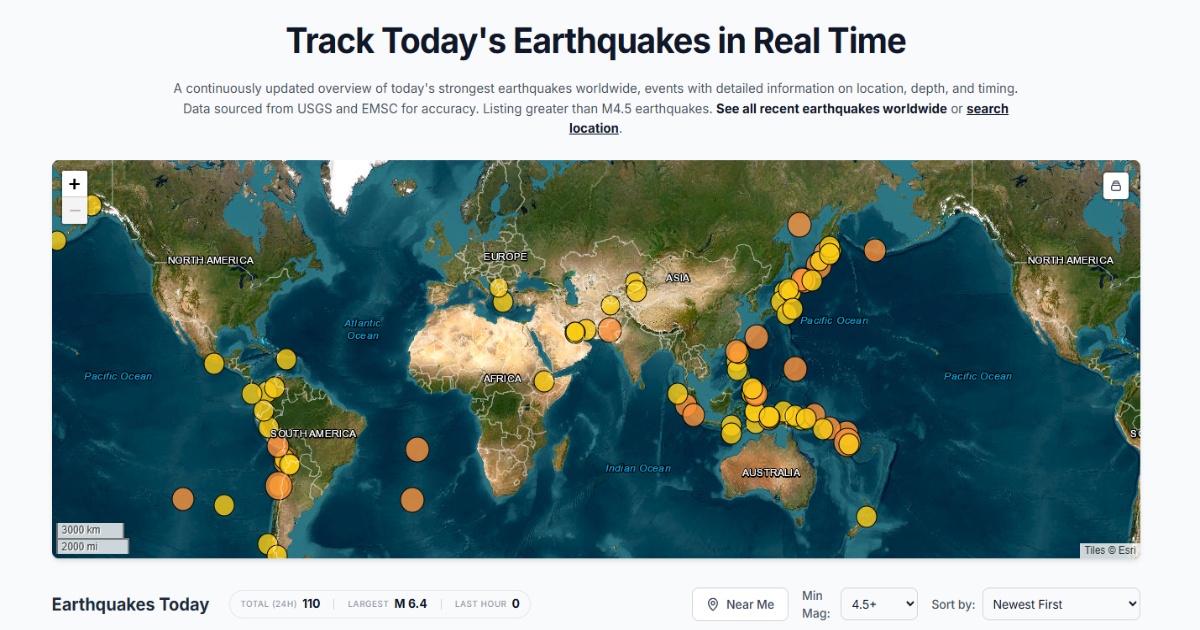
In a world where seismic activity is a constant, albeit often silent, force shaping our planet, staying informed about Earthquake Today events is paramount for safety, research, and general awareness. For anyone seeking precise, up-to-the-minute data on the planet's strongest tremors, two names stand out as global authorities: the United States Geological Survey (USGS) and the European-Mediterranean Seismological Centre (EMSC). These organizations serve as the bedrock for real-time earthquake monitoring, providing crucial information that helps scientists, emergency services, and the public understand the dynamic nature of our Earth.
The quest for accurate data on today's strongest earthquakes is more than just scientific curiosity; it's a critical component of disaster preparedness and risk assessment. From sudden jolts near populated areas to powerful offshore events with tsunami potential, each seismic incident tells a story of geological forces at play. By aggregating and disseminating data from vast networks of sensors worldwide, USGS and EMSC offer a comprehensive and continuously updated overview of significant seismic events, typically focusing on those with magnitudes of 4.5 or 5.0 and above, which are capable of causing noticeable shaking or damage.
Tracking Today's Strongest Earthquakes: Why Accuracy Matters
The Earth's crust is a mosaic of tectonic plates, constantly shifting and grinding against each other. This movement is the primary cause of earthquakes, which can occur at any time, anywhere. For many, the question of "Earthquake Today?" is a daily check, particularly for those living in seismically active regions. But not all earthquakes are created equal; while millions of tiny tremors occur annually, only a fraction are strong enough to pose a threat or even be felt by humans. Therefore, focusing on the strongest earthquakes, those above a certain magnitude threshold, is essential for practical monitoring and response.
Accuracy in reporting these events is not just a preference; it's a necessity. Incorrect or delayed information can lead to panic, misdirected aid, or a false sense of security. This is where organizations like USGS and EMSC become indispensable. They not only detect and locate earthquakes but also provide crucial details such as magnitude, depth, and precise timing. This data empowers scientists to study seismic patterns, helps engineers design more resilient structures, and enables emergency management agencies to issue timely warnings and mobilize resources effectively. Without this reliable, real-time data, our ability to respond to and mitigate the impact of major seismic events would be severely hampered.
The Pillars of Precision: USGS and EMSC Explained
When you seek information on global earthquake overview data, especially on today's strongest quakes, the USGS and EMSC are the go-to sources. Their commitment to scientific rigor, extensive global networks, and rapid data processing make them the definitive authorities. While both share a common goal, they operate with distinct regional focuses that ultimately contribute to a more robust global picture.
Who is the USGS?
The United States Geological Survey is a scientific agency of the United States government. While its primary mission is to serve the U.S. public, its reach and influence in seismology are global. The USGS operates the National Earthquake Information Center (NEIC), which is responsible for detecting and locating earthquakes worldwide as rapidly and accurately as possible. The NEIC plays a vital role in providing immediate earthquake data to national and international emergency response organizations, the media, and the general public.
- Global Network: The USGS relies on a vast network of seismic sensors and collaborates with international partners to gather data from nearly every corner of the globe.
- Rapid Analysis: Advanced algorithms and dedicated seismologists work 24/7 to process raw data, confirm events, and disseminate information within minutes of an earthquake occurring.
- Public Safety Focus: A core mission of the USGS is to provide information that helps reduce loss of life and property from natural hazards, including earthquakes.
Who is the EMSC?
The European-Mediterranean Seismological Centre (EMSC) is an international, non-governmental, non-profit organization that provides rapid information about earthquakes in the Euro-Mediterranean region and beyond. Founded in 1975, the EMSC serves as a central hub for earthquake information, collecting data from over 85 national seismic networks across 57 countries.
- European Focus, Global Impact: While its regional focus is Europe and the Mediterranean, the EMSC's sophisticated data aggregation and rapid alert systems contribute significantly to the global understanding of seismic activity.
- Crowd-Sourcing Capabilities: The EMSC pioneered the use of internet-based rapid information collection through eyewitness accounts, which helps quickly confirm felt events and assess their impact.
- Collaborative Approach: By integrating data from numerous national agencies, EMSC ensures a comprehensive and coherent picture of seismic events across a complex and often active geological region.
The synergy between USGS and EMSC, along with other national agencies, creates an unparalleled global earthquake monitoring system. When you check for "Earthquake Today" information, the data you see is often a product of their combined efforts, cross-verified and presented for maximum reliability.
Decoding Earthquake Data: What to Look For
Understanding the details provided by USGS and EMSC goes beyond just knowing that an earthquake has occurred. Each piece of information – magnitude, location, depth, and timing – offers critical insights into the event's potential impact and geological significance.
Magnitude: Understanding the Richter and Moment Magnitude Scales
Magnitude is arguably the most crucial piece of information about an earthquake. It is a measure of the energy released at the earthquake's source. While the Richter scale is commonly known, modern seismology primarily uses the Moment Magnitude Scale (Mw), which provides a more accurate and consistent measure, especially for larger earthquakes. It's a logarithmic scale, meaning each whole number increase represents a tenfold increase in amplitude and approximately 32 times more energy released.
- M4.5-M5.0+: These are the earthquakes that typically register on the USGS and EMSC "strongest earthquakes today" lists. They are often felt over wide areas and can cause minor damage, especially near the epicenter.
- M6.0-M6.9: Considered strong earthquakes, capable of causing significant damage in populated areas.
- M7.0-M7.9: Major earthquakes, potentially causing widespread severe damage.
- M8.0+: Great earthquakes, capable of catastrophic destruction over large regions and often triggering tsunamis.
Location, Depth, and Timing: The Critical Details
Beyond magnitude, these three factors paint a clearer picture of an earthquake's characteristics:
- Location (Epicenter): This specifies the point on the Earth's surface directly above the earthquake's origin (hypocenter or focus). Knowing the epicenter helps in assessing proximity to population centers, infrastructure, and potential hazards.
- Depth: The depth of an earthquake's hypocenter (where the rupture begins) has a profound effect on its impact.
- Shallow Earthquakes (0-70 km deep): Often more destructive, as the energy is released closer to the surface, causing more intense shaking.
- Intermediate Earthquakes (70-300 km deep): Can still be felt strongly but typically cause less damage than shallow quakes of similar magnitude due to greater distance from the surface.
- Deep Earthquakes (300-700 km deep): Generally cause less surface shaking over a wider area because the seismic waves lose energy traveling upwards.
- Timing: The exact date and time (usually Coordinated Universal Time - UTC) of the earthquake's occurrence. This is crucial for tracking aftershocks, correlating with eyewitness reports, and for scientific analysis of seismic sequences.
Beyond the Numbers: Practical Implications and Preparedness
Regularly checking for "Earthquake Today" updates from USGS and EMSC isn't just about satisfying curiosity; it's about being aware and prepared. While we cannot prevent earthquakes, we can take steps to minimize their impact.
Practical Tips for Earthquake Preparedness:
- "Drop, Cover, and Hold On": This is the recommended action during an earthquake. Drop to the ground, take cover under a sturdy table or desk, and hold on until the shaking stops.
- Prepare an Emergency Kit: Assemble a kit with water, non-perishable food, first-aid supplies, a flashlight, batteries, a whistle, and copies of important documents. Keep it accessible.
- Secure Your Home: Fasten heavy furniture, appliances, and water heaters to walls. Store heavy items on lower shelves.
- Develop a Family Plan: Discuss with your family what to do during an earthquake, where to meet afterward, and how to contact each other if separated. Identify safe spots in each room.
- Know Your Risk: Understand if you live in a seismically active area. Utilize resources from local emergency management agencies and geological surveys to assess your specific risk.
- Stay Informed: Follow official sources like USGS and EMSC for real-time updates and safety guidelines. Be cautious of unofficial social media reports that may not be accurate.
Understanding the detailed information provided by these leading agencies empowers individuals and communities to move from passive awareness to active preparedness. It highlights the dynamic nature of our planet and the continuous need for vigilance and readiness.
Conclusion: Staying Informed in a Dynamic World
The Earth is a living, breathing entity, constantly undergoing geological transformations. Earthquakes are a powerful manifestation of these processes, reminding us of the dynamic forces beneath our feet. Thanks to the tireless work of organizations like the USGS and EMSC, we have access to incredibly accurate and timely data on today's strongest earthquakes, whether you're looking for a global earthquake overview or details on specific seismic events. Their dedication to monitoring, analysis, and information dissemination not only advances our scientific understanding but also serves as a crucial backbone for public safety and disaster mitigation worldwide. By leveraging their data and embracing preparedness, we can all contribute to building more resilient communities in the face of seismic uncertainty, ensuring we are better equipped to respond when the Earth moves.