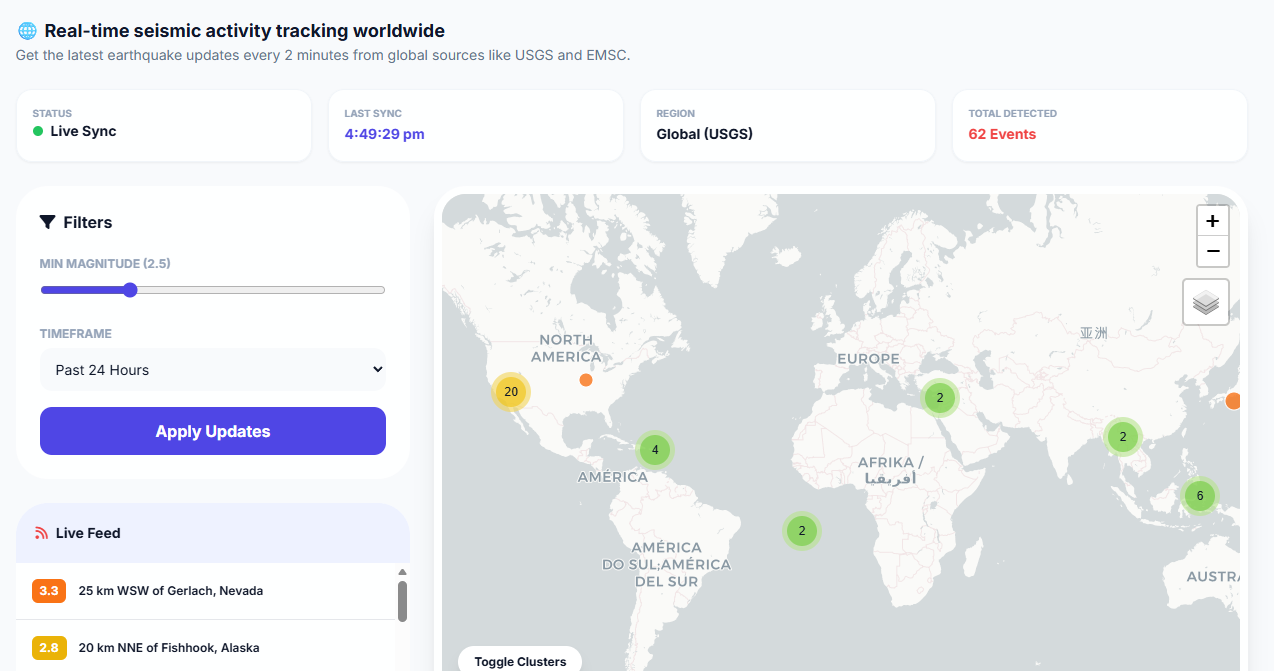
The Earth is a dynamic planet, constantly shifting beneath our feet. While often imperceptible, these movements periodically culminate in earthquakes, powerful reminders of our planet's immense geological forces. For many, understanding the latest seismic events is not just a matter of scientific curiosity but a crucial aspect of safety and awareness. This article provides a comprehensive overview of Earthquake Today: how these events are tracked, what key details matter, and how to interpret the global picture of seismic activity.
Every day, countless earthquakes occur worldwide, but only a fraction are strong enough to be felt or cause significant impact. Our focus is on providing a continuously updated perspective on these stronger events, typically those registering magnitudes of M4.5 and above, which are capable of affecting human populations and infrastructure. By examining location, depth, and timing, we can better understand the immediate implications of these powerful natural phenomena.
Understanding Today's Seismic Activity: What to Look For
When monitoring global seismic activity, certain parameters become paramount in assessing the potential impact of an earthquake today. It's not just about the absolute magnitude; context plays a critical role. A magnitude 5.0 earthquake in a densely populated urban area near the surface can be far more destructive than a magnitude 6.0 event deep beneath an uninhabited ocean.
Here’s what defines the "strongest" earthquakes we track:
- Magnitude Threshold: Generally, we focus on earthquakes with magnitudes of 4.5 and greater. Some tracking systems might prioritize M5.0+ events for immediate alerts, but M4.5 is a good baseline for significant seismic activity that warrants monitoring. These magnitudes indicate the energy released at the earthquake's source.
- Location: The epicenter's proximity to landmasses, especially populated regions, dictates the potential for damage and human impact. The Pacific Ring of Fire, for instance, is a notorious zone for frequent and powerful quakes due to its high concentration of active fault lines.
- Depth: Shallow earthquakes (typically less than 70 km deep) tend to cause more intense shaking at the surface compared to deeper quakes of the same magnitude, as the seismic energy has less distance to travel and dissipate before reaching the surface.
- Timing: Real-time tracking is essential for situational awareness and rapid response. Understanding the precise timing allows for the differentiation of main shocks, foreshocks, and aftershocks, which is critical for safety assessments.
Monitoring these factors allows individuals, emergency services, and scientific communities to stay informed and react effectively to the dynamic nature of our planet's crust. It helps transform raw data into actionable insights, vital for public safety and disaster preparedness worldwide.
The Science Behind the Shakes: Location, Depth, and Timing
To truly comprehend the impact of an earthquake today, it’s essential to delve into the key scientific details provided with each report: its location, depth, and timing. These aren't just arbitrary numbers; they are critical data points that paint a picture of the seismic event and its potential consequences.
Location: Pinpointing the Epicenter
The reported location of an earthquake refers to its epicenter—the point on the Earth's surface directly above where the earthquake originates, known as the hypocenter or focus. This geographical coordinate is crucial:
- It tells us which tectonic plates are involved and which fault lines may have ruptured.
- It indicates which communities might have felt the shaking and could be at risk.
- Coastal epicenters or those under the ocean can signal a potential tsunami threat, especially for very large quakes.
Understanding the location helps contextualize the earthquake within global seismic patterns, like the infamous "Ring of Fire" that encircles the Pacific Ocean, where about 90% of the world's earthquakes occur.
Depth: Shallow vs. Deep Tremors
The depth of an earthquake is measured from the Earth's surface down to its hypocenter. This detail significantly influences the intensity of shaking felt at the surface:
- Shallow Earthquakes (0-70 km deep): These are generally the most destructive. With less distance for seismic waves to travel, their energy remains concentrated, leading to more violent ground motion. Most significant damage and casualties result from shallow earthquakes.
- Intermediate Earthquakes (70-300 km deep): While still capable of causing significant shaking, the increased depth allows some energy to dissipate, often reducing surface intensity compared to shallow quakes of the same magnitude.
- Deep Earthquakes (>300 km deep): These are typically felt over a wider area but with less intensity at any given point on the surface. The deep travel path significantly attenuates the seismic waves, lessening their destructive power upon reaching the surface.
Timing: Real-Time Insights
The reported timing—down to the second—is vital for real-time tracking and analysis. It allows seismologists to:
- Correlate reports from different monitoring stations.
- Distinguish between main shocks, foreshocks (smaller quakes preceding a larger one), and aftershocks (smaller quakes following a larger one). Aftershocks can continue for days, weeks, or even months after a major event, posing ongoing risks.
- Provide immediate alerts to affected regions, giving crucial minutes or even seconds for people to react.
For a continuously updated view of these critical details, check out our Real-Time Earthquake Tracker: Latest Global Quakes Today, which aggregates information from leading global seismic networks.
Reliable Data Sources: USGS and EMSC in Focus
In the crucial field of earthquake monitoring, accuracy and speed are paramount. Fortunately, the world benefits from robust, independent organizations dedicated to tracking seismic activity globally. When you seek information about an earthquake today, the data typically originates from highly respected institutions like the United States Geological Survey (USGS) and the European-Mediterranean Seismological Centre (EMSC).
The United States Geological Survey (USGS)
The USGS is a scientific agency of the United States government that plays a leading role in global earthquake monitoring. Its Earthquake Hazards Program provides detailed and timely information on earthquakes around the world. Here's why the USGS is a cornerstone of seismic data:
- Global Network: The USGS operates a vast network of seismographs and collaborates with international partners to gather data from every corner of the globe.
- Scientific Expertise: With a team of world-renowned seismologists, geologists, and engineers, the USGS conducts extensive research to improve earthquake forecasting, hazard assessment, and public safety.
- Rapid Dissemination: Leveraging advanced technology, the USGS is adept at quickly processing seismic data and issuing alerts, magnitude reports, and shake maps to the public and emergency responders.
- Comprehensive Data: Beyond real-time alerts, the USGS maintains extensive historical earthquake catalogs, making it a valuable resource for long-term seismic trend analysis.
The European-Mediterranean Seismological Centre (EMSC)
The EMSC serves as a rapid information center for seismic events in the Euro-Mediterranean region and beyond. Established in 1975, it has grown into a vital organization for real-time earthquake monitoring, particularly complementing the global efforts of institutions like the USGS:
- Regional Focus, Global Impact: While its primary focus is the European-Mediterranean region, the EMSC quickly processes and distributes earthquake information globally, often being one of the first to release data for events outside its immediate geographical scope.
- Community Engagement: The EMSC pioneered the use of crowdsourced data (e.g., "Did You Feel It?" reports from citizens) to quickly assess the felt impact of earthquakes, adding a unique dimension to its data collection.
- Speed and Redundancy: EMSC's operational structure emphasizes speed, ensuring that initial earthquake parameters are released within minutes of an event. This provides crucial redundancy and cross-verification with other global seismic networks.
Both USGS and EMSC are committed to open data sharing, contributing significantly to public safety and scientific understanding worldwide. Their collaborative efforts ensure that reliable, accurate, and continuously updated information about an earthquake today is available to anyone who needs it. For more detailed insights into how these leading organizations collect and disseminate crucial data, refer to our article on USGS & EMSC: Accurate Data on Today's Strongest Earthquakes.
Preparing for the Unpredictable: Safety Tips and Awareness
While we can track earthquakes with increasing precision, predicting them remains impossible. Therefore, preparedness is our most potent tool against their destructive power. Staying informed about an earthquake today is one step; knowing what to do before, during, and after an event is another, equally critical step.
Before an Earthquake: Prepare Your Environment and Your Plan
Proactive measures can significantly reduce risks and facilitate recovery:
- Develop a Family Emergency Plan: Discuss with your family where to meet if separated, who to contact (an out-of-state relative often works best), and what to do in different scenarios.
- Build an Emergency Kit: Assemble a kit with water (one gallon per person per day for at least three days), non-perishable food, a first-aid kit, a flashlight, a whistle, a battery-powered radio, extra batteries, a wrench or pliers to turn off utilities, and copies of important documents.
- Secure Your Home: Fasten shelves to walls, secure water heaters and major appliances, hang heavy items (like pictures and mirrors) away from beds and sitting areas, and store heavy or breakable items on lower shelves.
- Identify Safe Spots: Know the safest places in your home (under sturdy tables or desks) and the most dangerous (near windows, large furniture, or unstable structures).
- Learn to Shut Off Utilities: Know where your main water, gas, and electricity shut-off valves are and how to turn them off in an emergency.
During an Earthquake: Drop, Cover, and Hold On
When the ground starts shaking, your immediate actions are crucial:
- If Indoors: DROP to the ground, take COVER under a sturdy table or desk, and HOLD ON until the shaking stops. Stay away from windows, fireplaces, and heavy furniture.
- If Outdoors: Move to an open area away from buildings, streetlights, and utility wires. Drop to the ground and stay there until the shaking stops.
- If in a Vehicle: Pull over to a clear spot, stop, and stay inside the vehicle with your seatbelt fastened until the shaking stops. Avoid stopping near or under buildings, trees, overpasses, or utility wires.
Do NOT run outside during an earthquake, as falling debris from buildings is a significant hazard.
After an Earthquake: Assess, Respond, and Recover
Once the shaking subsides, a new set of actions becomes necessary:
- Check for Injuries: Provide first aid where necessary.
- Check for Hazards: Look for gas leaks (smell for gas, listen for a hissing sound), damaged utility lines, and structural damage to your home. If you suspect a gas leak, turn off the main valve and evacuate immediately.
- Be Prepared for Aftershocks: These can be strong enough to cause further damage or collapse weakened structures.
- Stay Informed: Tune into a battery-powered radio for emergency information and instructions. Avoid using your phone unless it's an emergency to keep lines clear.
- Stay Safe: Do not re-enter damaged buildings. Stay away from coastal areas if you are in a region prone to tsunamis after a powerful offshore earthquake.
Earthquake preparedness is an ongoing commitment. Regularly review your plan and kit to ensure they are up to date and suitable for your family's current needs.
Conclusion: Staying Informed in a Shifting World
The daily occurrence of earthquakes around the globe underscores the dynamic nature of our planet. While the prospect of a major seismic event can be daunting, continuous monitoring and swift dissemination of accurate information provide us with invaluable tools. Understanding the key details of an earthquake today—its magnitude, precise location, and crucial depth—allows us to gauge its potential impact and stay vigilant.
Through the diligent work of organizations like the USGS and EMSC, we have access to real-time data that informs scientists, emergency responders, and the public alike. Coupled with robust personal and community preparedness strategies, this information empowers us to navigate the risks associated with seismic activity more safely and effectively. Staying informed and prepared isn't just about reacting to the next big shake; it's about building resilient communities that can withstand the planet's ever-present geological forces.